
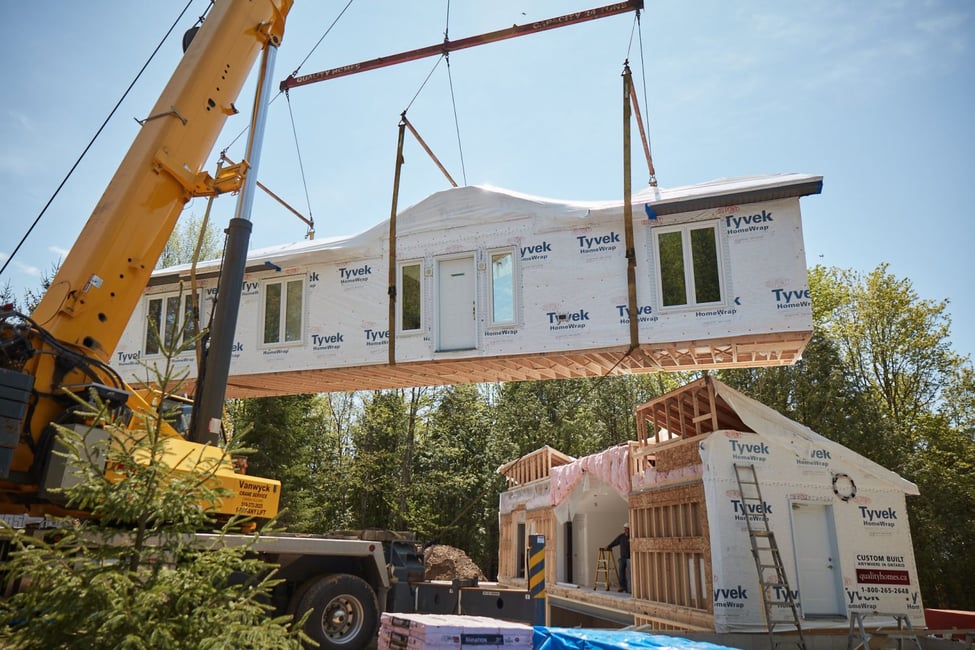
The Next Big Building Trend in Real Estate: Homes Built Like Products, Not Projects
For decades, most homes have been built roughly the same way: materials arrive on site, trades coordinate around weather and availability, and the final product slowly takes shape piece by piece.
But one of the most fascinating shifts happening in real estate right now is a move toward industrialized construction—a broader category that includes factory-built homes, modular housing, prefabricated components, panelized construction, and mass timber.
In simple terms, more of the home is being built before it ever reaches the site.
That might not sound glamorous at first, but it could become one of the most important building trends of the next decade—especially in markets like British Columbia, where housing affordability, labour shortages, construction timelines, energy efficiency, and land-use policy are all colliding at the same time.
This is not just about “prefab homes” in the old sense. The modern version is much more sophisticated.
We are now seeing entire wall systems, floor assemblies, bathroom pods, structural panels, and mass timber components being designed digitally, manufactured in controlled environments, and assembled on site faster than traditional construction methods.
For buyers, sellers, homeowners, and investors, this is a trend worth watching closely.
Why this trend matters now
The housing conversation is often focused on land, zoning, interest rates, and affordability. Those are all important, but there is another piece of the puzzle: how we physically build homes.
Traditional construction can be slow, expensive, weather-dependent, and difficult to scale. Every project becomes a custom coordination exercise involving permitting, design, trades, material delivery, inspection schedules, and site conditions.
Factory-built construction tries to solve part of that problem by moving more work into a controlled production environment. Instead of building every piece from scratch on site, components can be manufactured with more precision, better quality control, and less exposure to weather delays.
That matters because time is money in real estate.
A shorter construction timeline can reduce carrying costs. Better coordination can reduce waste. Repeatable designs can help create more predictable outcomes. And when paired with thoughtful zoning, these methods can make smaller infill, missing-middle housing, and multi-family projects more realistic.
That is the larger idea: not just building more homes, but building them in a more repeatable, scalable way.
The mass timber connection
One of the most interesting parts of this trend is the rise of mass timber.
Mass timber refers to engineered wood products such as cross-laminated timber, glue-laminated timber, and other structural wood systems that can be used in larger buildings. These materials are not simply “wood framing” in the traditional sense. They are engineered for strength, precision, and performance.
British Columbia is particularly well positioned for this conversation because of its forestry sector, sustainability goals, and growing interest in lower-carbon construction.
For a long time, wood was mostly associated with single-family construction and low-rise buildings. Mass timber challenges that assumption. It opens the door to taller, more complex buildings that still rely on a renewable material—something that fits well with B.C.’s natural resources and construction expertise.
Another advantage is speed.
Because mass timber components can be manufactured off site and assembled with a high degree of precision, they can reduce on-site construction time. That can be especially valuable in urban or infill settings where long construction timelines create disruption for neighbouring properties, traffic, and local businesses.
For communities that need more housing without endless construction delays, that kind of efficiency matters.
What this could mean for buyers
For buyers, this trend may eventually create more choice.
In many markets, including the Okanagan, buyers are often choosing between older resale homes, new custom homes, townhomes, condos, and infill product. Factory-built and mass timber construction could introduce more variety into that mix.
We may see more small-scale multi-family options, more purpose-built rental buildings, more efficient townhome developments, and potentially more well-designed secondary housing forms such as garden suites, laneway-style homes, or compact infill dwellings.
The key benefit for buyers is not simply speed. It is predictability.
A well-executed factory-built or panelized project can reduce some of the uncertainty that comes with traditional construction. In theory, that could mean fewer delays, tighter quality control, and better performance. Buyers may also become more interested in energy efficiency, indoor comfort, sound performance, and long-term operating costs—not just square footage and finishes.
That said, buyers still need to do their homework.
Not all modular or factory-built homes are equal. Quality depends on the builder, the system, the design, the installation, and the site work. Financing, insurance, warranties, strata considerations, and resale perception may also vary depending on the product and location.
The takeaway for buyers: this trend is promising, but it still needs careful due diligence.
What this could mean for sellers
For sellers, this trend is important because buyer expectations are changing.
Today’s buyers are increasingly aware of energy efficiency, lower maintenance, better design, and long-term operating costs. A home that feels inefficient, poorly laid out, or expensive to maintain may face more scrutiny, even if it has good square footage.
As new construction evolves, resale homes will be compared against a different standard.
That does not mean every older home needs to compete with brand-new construction. But it does mean sellers should think carefully about how their property is positioned.
A well-maintained older home with thoughtful updates, functional space, good storage, efficient systems, and a strong location can still compete very well. But homes with deferred maintenance, dated layouts, inefficient heating/cooling, or unclear future potential may need sharper pricing or stronger presentation.
For sellers, the practical lesson is simple: buyers are not just buying what a home is today. Increasingly, they are thinking about what it will cost to own, maintain, adapt, or improve tomorrow.
What this could mean for developers and landowners
For developers and landowners, industrialized construction may pair very well with another major real estate theme: zoning reform.
Across many B.C. communities, there is growing pressure to create more housing on existing land. That could mean more infill, more missing-middle density, more multi-family housing, and more creative use of underutilized lots.
Factory-built construction could become a natural fit for this environment.
When zoning allows more housing forms, builders need ways to deliver those homes efficiently. Repeatable building systems can help. Pre-designed components can reduce complexity. Mass timber can support mid-rise density. Modular construction can reduce time on site, which can be particularly valuable in established neighbourhoods where neighbours are sensitive to long construction timelines.
For landowners, this raises a fascinating question:
Is the value of a property based only on what is there today—or also on what could be built there more efficiently in the future?
That is where real estate advice becomes more strategic. The best opportunities may not always be the prettiest homes. Sometimes the opportunity is in the land, the zoning, the lot configuration, the servicing, the location, and the development pathway.
The caution: innovation does not erase fundamentals
As exciting as this trend is, it is not a magic solution.
There are still real challenges: financing, local permitting, transportation of modules, site preparation, labour coordination, builder capacity, public perception, and insurance.
That matters because real estate trends only become mainstream when the entire system can support them. Lenders, insurers, municipalities, builders, appraisers, buyers, and sellers all have to become comfortable.
So the most realistic view is this: factory-built and mass timber construction will not replace traditional construction overnight. But it will likely become a larger part of the housing mix, especially where speed, sustainability, repeatability, and density all matter.
Why the Okanagan should pay attention
The Okanagan has many of the same pressures seen across B.C.: limited land in desirable areas, high construction costs, affordability challenges, demand from both locals and relocating buyers, and a need for more diverse housing options.
That makes this trend particularly relevant here.
We may not see every neighbourhood suddenly filled with modular or mass timber buildings, but we are likely to see more conversations around efficient construction, secondary housing, multi-family infill, and alternative building systems.
For homeowners, that means your property’s future potential may matter more than ever.
For buyers, it means the next great home may not look like the traditional version of new construction.
For sellers, it means presentation and long-term value need to be communicated clearly.
And for communities, it means the way we build may become just as important as where we build.
Final thought
The most fascinating building trend in real estate right now is not one material or one design style.
It is the shift toward building homes more intelligently: with better systems, more precision, faster timelines, lower waste, and a clearer connection between housing demand and construction delivery.
Factory-built housing, modular construction, and mass timber are all part of that shift.
For the Okanagan, this is a trend worth watching—not because it changes everything tomorrow, but because it may quietly reshape what buyers expect, what developers can deliver, and what homeowners should understand about the future value of their property.
The homes of the future may not just be built on site.
They may arrive there—smarter, faster, and more thoughtfully designed than ever before.